
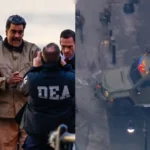
Venezuela’s deposed leader Nicolas Maduro arrived at a New York court on Monday to face drug charges while the U.N. was to debate the legality of U.S. President Donald Trump’s extraordinary operation to capture him.
In the biggest U.S. intervention in Latin America since the 1989 invasion of Panama, Special Forces swooped into Caracas on helicopters at the weekend to smash through Maduro’s security cordon and nab him at the door of a safe room.
Maduro and his also-captured wife Cilia Flores were taken by armed guards soon after 7 a.m. (1200 GMT) on Monday from a Brooklyn detention center to a helicopter that whisked them to the Manhattan federal court where they faced a midday hearing.
Maduro is accused of overseeing a cocaine-trafficking network that partnered with violent groups including Mexico’s Sinaloa and Zetas cartels, Colombian FARC rebels and Venezuela’s Tren de Aragua gang.
Maduro, 63, has long denied the allegations, saying they were a mask for imperialist designs on Venezuela’s oil.
Senior officials from his 13-year-old government remain in charge of the South American oil producer of 30 million people, first spitting defiance then pivoting to possible cooperation with the Trump administration.
Though denouncing Maduro as a dictator and drug kingpin who flooded the U.S. with cocaine, Trump has made no bones about wanting to share in Venezuela’s oil riches.
It has the world’s largest reserves – about 303 billion barrels, mostly heavy oil in the Orinoco region. But the sector has long been in decline from mismanagement, under-investment and U.S. sanctions, averaging 1.1 million bpd output last year, a third of its heyday in the 1970s.
After first denouncing Maduro’s capture as a colonial oil-grab and “kidnapping”, Venezuela’s acting president Delcy Rodriguez changed her tune on Sunday, saying it was a priority to have respectful relations with Washington.
“We invite the U.S. government to work together on an agenda of cooperation,” Rodriguez said. “President Donald Trump, our peoples and our region deserve peace and dialogue, not war.”
The post Venezuela’s Maduro at US court, substitute leader softens stance appeared first on nationnews.com.