

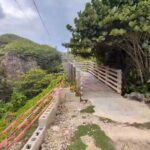
High Court Judge, Patrick Wells has issued an order permanently restraining multimillionaire Richard Haines, the developer of Joe’s River, from erecting “any obstruction of whatsoever kind” at the public right of way of the historic Joe’s River Bridge.
A 48-page judgment delivered early yesterday morning – a week after conclusion of the case – was entered for claimants Victor Lewis and Christopher Oliver, who brought the case against Haines, the landowner, in 2023 when he attempted to construct two guardwalls at the entrance of the Joe’s River Bridge.
Tenby Foot Bridge
“Effective immediately and in perpetuity, the court declares that there is an absolute and indefeasible prescriptive public right of way at the southern end of the Tenby Foot Bridge at Tenby, Joe’s River, St Joseph [facing the direction of Bathsheba], which goes both east and west [left and right] into the Joe’s River basin and includes the Joe’s River basin in the immediate environs of the Tenby Foot Bridge; the path leading up to the teacup and saucer concrete monument; and the area immediately surrounding the monument.”
Wells ordered the walls removed and awarded cost to the claimants.
“The defendant is permanently restrained from causing or permitting, whether by itself or its agents and or its servants the erecting of any obstruction of whatsoever kind, including but not limited to concrete walls, anywhere in the declared prescriptive public right of way identified at paragraph 2. Any structure of whatsoever kind, which has been erected in the path of the prescriptive public right of way described and declared in paragraph 2 above, by the defendant, its agents and or servants, shall be dismantled and be removed immediately by the defendant.”
Wells said he had accepted the evidence of Oliver and Haynes that Barbadians daily traversed the Joe’s River site over the years and that visitors used the teacup and saucer to relax and to admire the Bathsheba vista and that the right of way had always been at the southern end of Tenby Bridge where the defendant had started to erect the wall.
Pointing out that the court had also visited the site, the judge stated: “I believe this evidence in its entirety and therefore find that it establishes decades of continuous use by not only Mr Oliver himself, but by the community, as well as visitors to the area who saw the river basin and the teacup and saucer monument as recreation.
Continuity
“Even if the use was intermittent the law makes clear that the degree of continuity is based on the type of right of way. In this case, the right of way was to access the river basin and the teacup and saucer monument for recreational purposes. In that regard, the access would not have been expected to be on a 24-hour or daily basis, but sufficiently regular to demonstrate continuous use.
“All the evidence that the court has adverted to thus far, leaves the court in no doubt that such continuous use for over 70 years was the true state of affairs and it is that access and right of way that the defendant has now sought to obstruct, with the construction of the concrete wall on either side of the railway trace, at the exit of the southern edge of the
bridge. The court, having visited and toured the area with the parties, was able to see for itself that on the northwestern edge of the Tenby Bridge, overlooking the river basin, there was in fact a very high precipice and a cliff face, that was simply unusable.
Treacherous
“The court was also able to see the northeastern end of the Tenby Bridge on the Cattlewash side, and it was obvious to the court as well that it would have been fairly treacherous to have entered the river basin from that end of the bridge. That section was heavily overgrown with a mass of trees and had a number of somewhat jagged rocks and small boulders at the base.”
The court, however, rejected Haines’ testimony that it was not his intention to block or impede the Government railway trace and that the wall which he was erecting was solely for the purpose of providing a measure of security and privacy to occupiers of his villa. Wells further found his testimony that the wall on the southeastern end of the bridge, which blocked the right of way, was to provide reinforcement of the banking, to be “wholly illogical and confounding”.
Wells stated: “In the first, that the wall was meant to be a ‘garden wall’, was untruthful and incredulous. There was no garden at that location of the property on either the western or eastern side of the southern end of the Tenby Bridge . . . Secondly, if it was not intended to block access to the river by the persons who traversed the area, there would have at least been a proper entry and egress . . . , instead of a concrete wall which would necessitate scaling it . . . in order to get into the river basin.”
He found that the real intention of the construction of the walls was to block the right of way enjoyed by the claimants which they were using for over 70 years as he explained that the Limitation and Prescription Act, states that where a lawful claim to the right of enjoyment of any way or easement over land, which is the property of another person or body corporate is made, and that enjoyment by the person claiming the right has occurred without interruption, for the full period of forty (40) years, that right shall be deemed to be absolute and indefeasible, unless it appears that the land was enjoyed by some consent or agreement, expressly given or made for that purpose by deed or writing.
“On the basis of all the factual findings discussed and made in this decision, and the determinations made in law, the claimants in this case have established to the full satisfaction of this court, on a balance of probabilities, that they, and the community surrounding the location of the right of way at the Tenby Bridge, St Joseph, as well as other members of the general public, have exercised a prescriptive right of way over the land now owned by the defendant for at least – over 70 years, and that the enjoyment of this right has been without interruption, and without consent or agreement expressly given or made for that purpose by deed or writing.” (MB)

The post Public has ‘right of way’ appeared first on nationnews.com.